
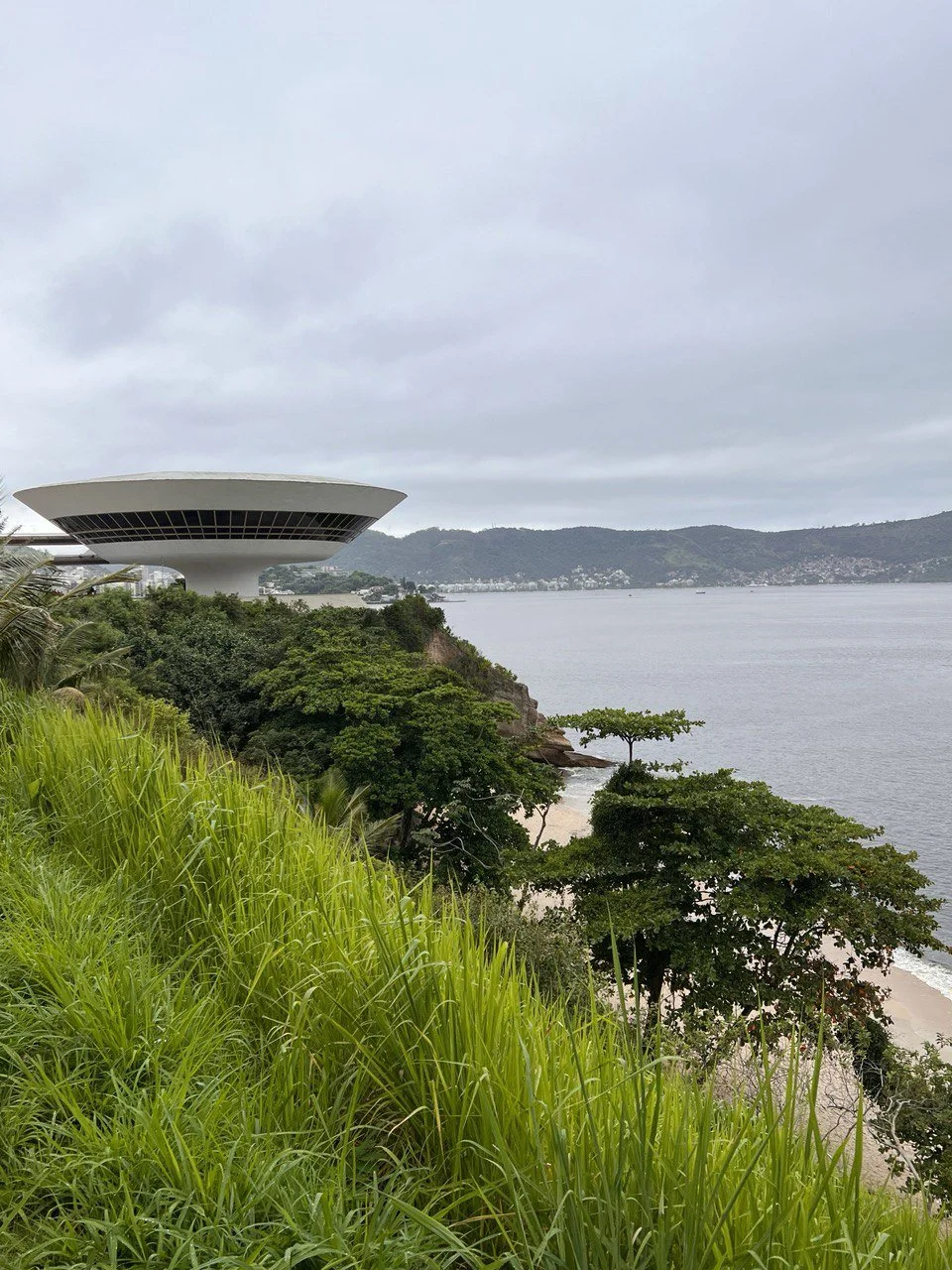
MAC Niterói, near Rio de Janeiro
In the museum’s manifesto, one reads: “Culture is everywhere, and culture is your right.” A statement that is hard to argue with.
Yet when entering a museum, one expects a curated selection — something distilled through the expertise of art professionals — rather than a mere continuation of what already surrounds us everywhere. In other words, visitors usually hope for something more than what is simply framed as “everywhere.”
After visiting the museum, however, the strongest emotions and memories remain tied almost exclusively to the architectural shell, not to the content inside — unfortunately so.
The building was designed by Oscar Niemeyer, the legendary Brazilian architect and Pritzker Prize laureate. Niemeyer also played a central role in shaping Brasília, Brazil’s capital, and often described the Mondadori headquarters in Milan as one of his favorite projects. The MAC Niterói, completed in 1996, is one of his most iconic late works — a futuristic structure resembling a flying saucer hovering above Guanabara Bay. The building is elevated on a narrow cylindrical base and accessed via a long, curved ramp, a gesture that turns the act of entering the museum into a performative experience in itself.

Returning to the museum’s exhibitions, it is noticeable that relatively few tourists actually buy a ticket and go inside. There are two main reasons for this. First, in the 21st century, a contemporary art museum that does not accept electronic payments (cash only) inevitably shocks visitors. Second, the museum’s reputation for a rather mediocre exhibition program has spread so widely that curiosity rarely wins — and those willing to check it for themselves are, sadly, few.
That said, the museum is home to one of the most important collections in Brazil: the João Sattamini Collection. Sattamini was a major collector and art dealer whose role in shaping the narrative of Brazilian and Latin American modern and contemporary art cannot be overstated. The collection includes painting, sculpture, and works on paper, and places particular emphasis on movements that are central to Brazilian art history — Concrete Art and Neo-Concrete Art. Artists associated with these movements sought to move beyond rigid rationalism toward more sensorial, participatory, and embodied forms of abstraction, making the collection historically and conceptually significant.
Verdict: highly recommended — both for the architectural form and for the content.
P.S. Don’t forget to bring cash.